

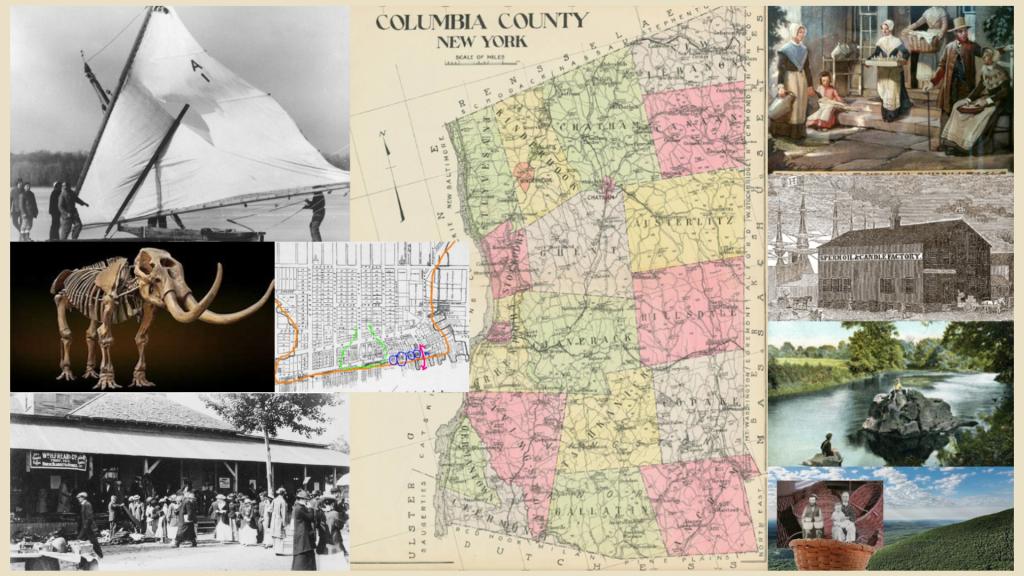
How well do you know Columbia County and Hudson? We bet there’s plenty of locals who don’t know some of these factoids! Here is our list of the Top 10 Things You Didn’t Know About Columbia County!
1. First Incorporated City – Before it was known as “Hudson”, it was called “Claverack Landing” and on November 14, 1784, it became the first city to be incorporated in the brand-new United States of America.
2. Hudson was Planned Company Town – Brothers Seth and Thomas Jenkins arrived in “Claverack Landing” in 1783 with the goal of relocating their whaling operation after being driven out of Nantucket by British forces. Together with 28 other whalers, the brothers formed a company that laid out a city grid and put into place everything a whaling enterprise would need including ship builders, rope and sail makers, coopers, and a spermaceti-works. Within 3 years the budding new city would house 1,500 people.
3. Ice Sailing, or ice yachting, on the Hudson River is a winter tradition where people sail on specially designed crafts propelled by sails, a sport with roots dating back to the 1800s. An antique ice yacht dubbed “Vixen” that was built in 1886 and once owned by John A. Roosevelt (FDR’s uncle), can be seen occasionally skimming across the frozen Hudson River by Columbia County resident and 50-year ice yachting veteran Reid Bielenberg.
4. One of The Oldest County Fairs in America is held in Chatham on Labor Day weekend. Dating back to 1841, the Columbia County Fair once hosted the Rockefellers as its guests.
5. The Pondshiners were a group of people with an “intense fear of strangers” who hid in the hills in the Town of Taghkanic. Rumors of witchcraft and strange superstitious rituals spread throughout the state. The pondshiners, or “hillbillies”, survived by hunting and farming with their only source of income coming from basket weaving. These rounded baskets, which were woven from strips of hardwood, were considered superior even to Shaker handiwork.
6. The Legend of Spook Rock – This idyllic spot on the Claverack Creek is said to be the final resting spot of two starcrossed lovers. As the story goes, a beautiful Mahican maid fell in love with a young man from an opposing tribe, defying the wishes of her father. One fateful night, the couple made their rendezvous under an overhanging rock near the creek bed. As lightning flashed and thunder roared, both were swept from the mountain with the rock which came crashing down to the stream below, burying them beneath its ponderous weight. Some have claimed to hear the maiden’s ethereal cries or see her apparition wandering this stretch of road in search of her lover.
7. The First Shaker Community was founded in New Lebanon in 1787 and served as the central ministry and organization for all Shaker communities that emerged throughout New England, and later in the south and west. The Mount Lebanon Shaker Society closed in 1947 and the site is now a National Historic Landmark with a museum.
8. The Claverack Giant was one of the most significant fossil finds in American history. In 1705, a Dutch tenant farmer found a massive five-pound prehistoric tooth on the banks of the Hudson River. The native Mohicans in Columbia County, who had long collected such fossils, believed the tooth belonged to an ancient giant that they called “Maushops”. Scientists would later identify it as an Ice Age mastodon tooth, the first recorded discovery of its kind.
9. The Hudson Historic District, which includes most of downtown, was once known as “one of the richest dictionaries of architectural history in New York State”. Listed on the National Register of Historic Places in 1985, the district contains examples of every major American architectural movement with its 756 contributing properties in a 45 block area. Hudson’s main artery Warren Street is the most intact 19th-century main commercial street in New York State.
10. Hidden Hamlets and Vanishing Villages – The Columbia County Historical Society has a guide to the hidden hamlets of the county. As the County took shape during the 18th and 19th centuries, settlements sprang up around river landings, rail stops and mill sites. While some survived the test of time, others faded into history with name changes or were swallowed up by larger towns. Who remembers places like Cheviot, Viewmont, Blue Stores, Buckleyville, Boston Corner, Sober or Smokey Hollow?